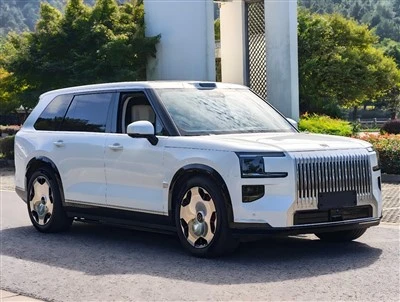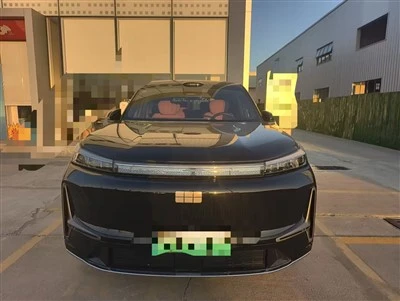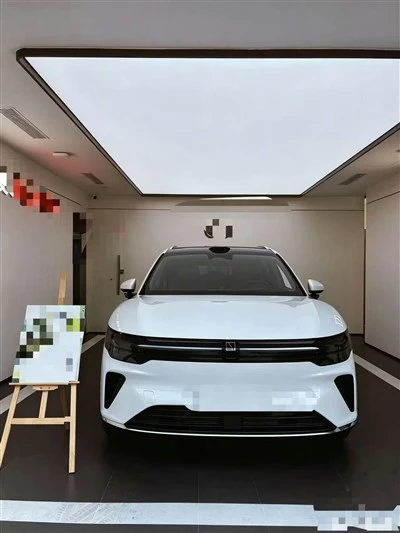



Fangchengbao will launch the Tai 9 after 15 November 2026, with show and demonstration cars reaching dealers from late October. It is the brand's first 9-series model: a 5,270 mm six-seat SUV aimed at the RMB 400,000 class, positioned against the Li L9 and the AITO M9.
The specification is built around one idea - that the third row should not be a penalty. All three rows get ventilation, heating and massage. The second row has independent zero-gravity seats with more than 140 degrees of recline, a powered leg rest and lateral adjustment. The passenger seat has a cradle mode for sleeping.
Underneath, there is a plug-in hybrid system using BYD's sixth-generation DM-i technology, a 66.48 kWh blade battery, 310 km of WLTC electric range, and more than 1,600 km combined. Around it, a monocoque body, dual-chamber air suspension, rear-wheel steering and an all-terrain mode system.
Prices have not been published. Market expectation is around RMB 400,000, and the manufacturer has not confirmed that figure, so treat it as an estimate until the launch event.
Dimensions and Packaging
| Item | Figure |
|---|---|
| Length, width, height | 5,270 mm, 1,999 mm, 1,850 mm |
| Wheelbase | 3,130 mm |
| Seating | Six, 2+2+2 |
| Approach and departure angles | 19 degrees and 22 degrees |
| Boot | 655 litres, 1,245 litres with the third row folded, plus 60 litres underfloor |
| Tailgate | Split upper and lower doors, 300 kg load rating, 5-second cycle, holds between 0 and 72 degrees |
The split tailgate is a practical feature rather than a styling one. The lower half drops to form a seat or a loading platform rated at 300 kg, and because it holds at any angle between closed and 72 degrees, it works as a bench, a work surface or a step. On a vehicle sold into markets where the back of the car doubles as a workplace, that is worth more than most of the interior technology.
The 3,130 mm wheelbase is longer than that of the Li L9 or the AITO M9 by the manufacturer's own comparison, and the packaging is what that length buys: a third row that adults can use for a long journey, and 655 litres of boot space behind it.
Powertrain and Range
The system pairs a 1.5-litre turbocharged engine rated at 115 kW with two permanent-magnet synchronous motors, one on each axle, for a combined 400 kW. Drive is through all four wheels, and top speed is quoted at 220 km/h.
The battery is a 66.48 kWh second-generation blade pack, which is large for a plug-in hybrid and is the reason the car covers 310 km on electricity alone. That figure is WLTC rather than CLTC, which makes it more conservative and more comparable with European testing - a meaningful distinction, because a 310 km WLTC rating is roughly what a 380 to 400 km CLTC car would deliver.
Combined range is quoted at more than 1,600 km. In practice the number that matters to a buyer in a market with unreliable charging is the electric range, because 310 km covers several days of urban driving, and the engine then removes any dependence on infrastructure for the long trip.
The platform is described as a new hybrid architecture, and it uses a monocoque body rather than a ladder frame. That is a deliberate choice: it delivers car-like refinement and lower weight, at the cost of the torsional toughness that a body-on-frame design offers under sustained heavy load on bad roads.
Chassis and All-Terrain Systems
The chassis uses Yunian-A body control with dual-chamber air suspension and road preview, which reads the surface ahead and adjusts damping before the wheels reach it. There is also rear-wheel steering, giving a turning radius under five metres, and an intelligent all-terrain system that identifies ice, sand, mud and gravel and adjusts the powertrain and chassis accordingly. A stability system for a tyre blowout at speed is fitted.
That combination is the current Chinese formula for a luxury off-roader: air suspension for comfort, rear steering for manoeuvrability in cities, and software modes for the surfaces the car will rarely see. Each element works, and each adds a system that needs diagnostic support to repair.
For an importer, the risk profile is clear. Air suspension, rear steering and an electronically controlled all-terrain system are all dealer-level repairs. In a market without a Fangchengbao workshop, any one of them failing can take the vehicle off the road for weeks.
Cabin and Equipment
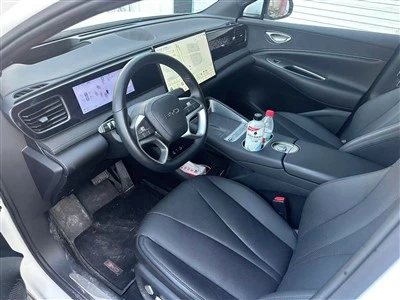
The front of the cabin carries a 30-inch 5K panoramic display, and there is a 21.4-inch roof-mounted screen for the rear. The manufacturer quotes up to ten connected screens in total, running the DiLink system. Audio is a 31-speaker Devialet arrangement with headrest speakers in the first two rows, and there is an 11.3-litre double-door refrigerator.
Seats are Nappa leather across three rows, with ventilation, heating and massage throughout; the third row also gets its own climate vents, cupholders and charging ports. The second row has independent captain's chairs.
Driver assistance is God's Eye B 5.0, fitted as standard across the range, with a roof-mounted lidar. As with every Chinese system of this generation, the assisted driving functions depend on mapping and regulatory approval in the destination; the hardware travels, the features often do not.
How It Compares
| Factor | Fangchengbao Tai 9 | Typical large six-seat hybrid SUV |
|---|---|---|
| Length and wheelbase | 5,270 mm and 3,130 mm | 5,100 to 5,250 mm and about 3,050 mm |
| Electric range | 310 km WLTC | 150 to 200 km WLTC |
| System output | 400 kW, four-wheel drive | 300 to 380 kW, four-wheel drive |
| Third-row equipment | Ventilation, heating, massage, own climate | Ventilation and charging on top trims only |
| Overseas service network | Minimal; brand is China-focused | Established for the major brands |
The last row is the honest caveat. On product the Tai 9 is competitive or ahead; on the support structure a retail buyer depends on, it is behind, and the price advantage has to be large enough to pay for that gap.
Export Assessment
- Where it fits. Gulf markets, Central Asia and West Africa, for families and corporate buyers who want six usable seats, high equipment and long electric range without depending on charging.
- Where it does not. Markets without a workshop capable of air suspension, rear steering and high-voltage work, and markets where 5.27 metres and a 1,999 mm width make parking and lane discipline difficult.
- Brand and warranty. Fangchengbao has almost no overseas retail presence. An exported car has no factory warranty outside China unless the importer provides one.
- Certification. Destination approval is required regardless of Chinese type approval: GSO/SASO in the Gulf, TR CU in the EAEU, pre-shipment conformity in most of Africa.
- Charging. Chinese GB/T connector. Confirm whether an export configuration exists before promising DC charging.
- Fuel quality. A modern turbocharged engine with emission control is sensitive to sulphur content. Establish the fuel specification in the destination before ordering.
Our SUV range covers the models we source, and the Central Asia import guide sets out the certification and tax path for markets where this class of vehicle sells.
Frequently Asked Questions
How much will the Fangchengbao Tai 9 cost?
The manufacturer has not published a price. Market expectation is around RMB 400,000, and the official figure will be confirmed at the launch after 15 November.
How many seats does it have?
Six, in a 2+2+2 layout, with the third row folding flat.
What is the electric range?
310 km on the WLTC cycle from a 66.48 kWh blade battery, with more than 1,600 km combined using the petrol engine.
Is it a real off-roader?
It has air suspension, all-terrain modes, 19-degree approach and 22-degree departure angles and four-wheel drive, but it is built on a monocoque body, so it suits rough roads better than sustained heavy-duty use.
Can it be exported?
Left-hand-drive markets can be supplied through dealer channels, subject to certification. Warranty and service are the main constraints.
Does it need charging to be economical?
No. It works as a hybrid without charging, but the 310 km electric range is what delivers low running costs, so a buyer with home charging gets much more from the car.
Sources
1. Autohome - Tai 9 launch timing and specification report, including dimensions, angles, boot volumes, tailgate load rating, powertrain, battery, range and chassis systems, 27 October 2026 - autohome via cnfol.com
2. Autohome Chejiahao - November 2026 launch roundup confirming the Tai 9 as a large six-seat SUV with the sixth-generation DM-i system and WLTC range figures - chejiahao.autohome.com.cn
3. Fangchengbao official website - brand and model information - fangchengbao.com
Prices are market estimates; the manufacturer has not published official pricing, and specifications may change at the launch event after 15 November 2026. Range figures are manufacturer claims on the WLTC cycle. Export availability, certification and landed cost must be confirmed for each destination. Nothing in this article is a quotation.