


Search for which Chinese NEV brands are available used for export and you will mostly get one of two things: a long introduction to the brands themselves, or a numbered list of exporters. Neither answers the question a buyer actually has, which is much narrower. Of the brands you can name, which ones have a real used unit sitting in stock right now, with a specification sheet you can open, a recorded mileage, a registration date and a condition note you can check before you pay?
This page answers that question from our own live stock rather than from a brand catalogue. At the time of writing there are 25 used new-energy units with their own specification pages under our /used-car/ section, filed under 12 brand labels. That is a small, concrete set, and it is deliberately not a ranking. A brand appearing here means we have a page for a specific unit, not that the brand is better, bigger, easier to export or officially approved in any way.
Two things follow from that. First, we describe what is on the pages, including the awkward parts: two units carry foreign badges, three units have powertrain labels the pages ask you to confirm, one unit shows 0 km but is already registered, and one mileage is printed as an approximation. We reproduce those labels rather than tidying them into confident-sounding claims. Second, we keep brand introductions somewhere else. If you need a full model line-up, technology background or a new-car comparison, our brand pages do that job. This page is only about used availability, and it links to the brand pages instead of competing with them.

What Available Means on This Page
Available is the word that causes most of the confusion in this query, so it is worth fixing before any brand names appear. On this page a unit counts as available only when all four of the following are true. It has its own published specification sheet on our site, with a URL you can open. That sheet states a mileage figure or an explicit approximation. It states a model year, a production date or a registration date. And it says something about price basis or condition, even if what it says is on request.
What does not count: a model name in a manufacturer catalogue, a vehicle described as coming soon, a page that only repeats new-car specifications, and any claim that a brand can be sourced without pointing to a specific unit. Those are sourcing statements, not availability. We also exclude our own general category pages from the count. The used car section is the index we check against, but the 25 units are the individual specification pages beneath it.
Availability here also does not mean availability for your destination. Whether a given unit can be imported, registered or driven in a specific market depends on that market's rules, and those rules are not Chinese export conditions. Our main guide to importing used cars from China separates the two questions and explains why we do not publish destination duty rates, fixed age limits or scrappage amounts when sources disagree. What this page tells you is what is physically listed, in China, today.
The snapshot date matters as much as the count. Stock changes: units sell, pages get updated, and new units are added. We treat the figures here as a dated reading of live pages, not as a permanent statement about any brand. Later in the page we explain how we handle that drift, including keeping our mileage-ordered stock list in step with the live pages.
Quick Answer Twelve Brand Labels Twenty Five Units
Here is the short answer before the detail. The 25 units fall under 12 brand labels, and the distribution is uneven: one label holds seven units, two hold three each, three hold two each, and six hold a single unit each. If you came here to find out whether a particular brand has anything in stock, this table is the answer; the sections below explain what each row actually contains.
| Brand label used on our site | Units in stock | Representative models | Mileage range shown | Powertrain labels shown |
|---|---|---|---|---|
| BYD group | 7 | BYD M9, BYD Seal 07 EV, BYD Song L DM-i, BYD Sea Lion 06 DM-i, BYD Yangwang U8, Fangchengbao Bao 5 (two trims) | 4,200 km to 34,721 km | PHEV, EREV, BEV |
| Changan group | 3 | Deepal S07, Changan Qiyuan Q06, Changan Qiyuan Q07 | 7,300 km to 20,000 km | All three rows ask for confirmation |
| XPeng | 3 | XPeng G7 Max EREV, XPeng G7 702 Ultra, XPeng X9 | 2,600 km to 32,482 km | EREV, BEV |
| GAC AION | 2 | GAC AION UT Super, GAC AION i60 | 7,100 km to 8,400 km | BEV, EREV |
| Xiaomi | 2 | Xiaomi YU7 Pro, Xiaomi YU7 Max | 6,500 km to 21,900 km | BEV |
| Zeekr | 2 | Zeekr 7X, ZEEKR 9X | 2,500 km to 11,000 km | BEV, PHEV |
| Audi | 1 | Audi E5 Sportback Flagship quattro | 8,800 km | BEV |
| AVATR | 1 | AVATR 12 Max dual-motor | 6,500 km | BEV |
| Dongfeng group | 1 | VOYAH Taishan Max | 3,800 km | PHEV |
| Geely group | 1 | Geely Galaxy M9 210KM AWD Navigator | 3,600 km | PHEV |
| Huawei group | 1 | AITO M9 Ultra EREV 6-seat | 0 km | EREV |
| Toyota | 1 | Toyota bZ3 PRO | 5,800 km | BEV |
The shape of that table is the finding. A single label accounts for more than a quarter of the whole stock, half the labels have only one unit, and the widest mileage range inside one label is over 30,000 km. Used availability is lumpy. It reflects which specific cars happen to be in stock, not a tidy spread across the Chinese NEV industry. Any answer that reads like a balanced brand overview is answering a different question.
How We Group the Brands
The grouping above follows the category folders on our own site, not a corporate ownership chart. When a used unit is published it is filed under a brand folder such as byd, changan, xpeng, aion, xiaomi, zeekr, audi, avatr, dongfeng, geely, huawei or toyota. Those folder names are the labels a buyer sees when browsing, so they are the labels we use here. They are practical filing labels. We are not asserting legal ownership, licensing arrangements or authorised-distributor status for any nameplate, and we ask you not to read the grouping that way.
Six of the folders hold more than one nameplate or sub-brand, and it is worth being explicit about what sits inside each. The BYD folder contains BYD-badged models alongside Yangwang and Fangchengbao units. The Changan folder contains Changan Qiyuan models alongside a Deepal. The Dongfeng folder holds a VOYAH. The Huawei folder holds an AITO. The Geely folder holds a Galaxy. The GAC AION folder holds AION-badged models, and we use AION as the label rather than GAC because that is how the folder is named. XPeng, Xiaomi, Zeekr, AVATR, Audi and Toyota each appear under their own folder name in this stock.
That distinction matters for two reasons. First, if you are searching for a used Yangwang U8 or a used Fangchengbao Bao 5, you will not find it by looking only for the word BYD in a model title, so the grouped view is genuinely useful. Second, writing a brand history for each of those names would duplicate our brand pages, which already cover line-ups and positioning. We link to them from every row in the table above and from each brand section below, and we keep this page focused on which units are in stock under each label.
One more boundary: the presence of a label here says nothing about export eligibility. Export qualification, the licence and the declaring entity are separate matters governed by national rules, and our verification guide for used car export companies turns those rules into a document checklist. A brand being in stock and a shipment being compliant are two different checks.
Two Foreign-Badge Models in a Chinese Used Stock List
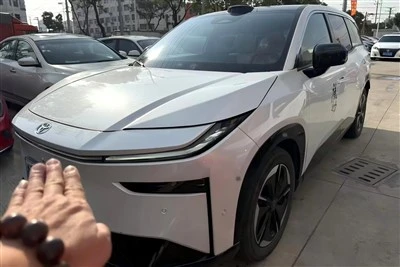
The question asks about Chinese NEV brands, so we should be honest about two rows that do not fit that phrase neatly. Of the 25 units, two carry badges that are not Chinese domestic brands: the Audi E5 Sportback Flagship quattro at 8,800 km and the Toyota bZ3 PRO at 5,800 km. Both are battery-electric vehicles listed in our Chinese used stock, both have their own specification sheets, and both would be exported from China. They are in the count because the count is about units in our stock, not about brand nationality.
We are not going to redefine Chinese brand to make the list look cleaner, and we are not going to claim these are domestic marques. If your enquiry specifies a Chinese domestic brand, these two units need to be excluded or explicitly accepted in writing. If your enquiry is about sourcing used new-energy vehicles out of China regardless of badge, they belong in the same comparison as everything else. The Audi brand page and the Toyota brand page cover those line-ups; this page only records that one used unit of each is currently listed.
This is also a useful reminder about how stock lists get written. A page that answers this query by listing only domestic marques is either filtering deliberately or has not looked at its own inventory. We would rather show the two rows and the caveat, because a buyer who discovers the discrepancy after a proforma invoice is issued has a much more expensive problem than a buyer who reads it here.
BYD Seven Units Across Three Nameplates
The BYD folder is the deepest group in the stock, with seven units, and it is the only one where a buyer can compare several trims, powertrains and price bases under a single label. Three nameplates appear inside it: BYD-badged models, Yangwang, and Fangchengbao. The table below reproduces the mileage, year, powertrain and price basis exactly as our mileage-ordered stock list records them.
| Unit and specification sheet | Year | Mileage | Powertrain | Price basis shown |
|---|---|---|---|---|
| BYD M9 1060 Pilot Pro | 2025 | 4,200 km | PHEV | $25,846 FOB |
| BYD Seal 07 EV 705 Flagship | 2026 | 5,267 km | BEV | $23,046 FOB |
| Fangchengbao Bao 5 Laser Edition | 2025 | 9,100 km | PHEV | On request |
| BYD Song L DM-i 112 km Beyond | 2025 | 11,500 km | PHEV | On request |
| Fangchengbao Bao 5 210 km Qiankun Ultra | 2025 | 12,900 km | PHEV | On request |
| BYD Sea Lion 06 DM-i 205 km Navigator | 2025 | 15,000 km | PHEV | ref. RMB 156,800 |
| BYD Yangwang U8 Luxury 4WD EREV | 2023 | 34,721 km | EREV | RMB 840,000 |
Three things stand out. The mileage range is the widest in the whole stock, from 4,200 km to 34,721 km, so this group is not uniformly near-new. Five of the seven units are labelled PHEV, one EREV and one BEV, which means the group is also the clearest place to see how a single label spans different powertrains. And the price column contains four different kinds of entry: a US dollar FOB figure, on request, a reference RMB figure, and a plain RMB figure. We do not convert them into one column because they are not the same thing; the FOB price breakdown explains what each basis includes.
The Seal 07 EV is the newest addition here. Its sheet gives a production date of May 2026, a registration date of 23 May 2026, 5,267 km, original body panels and paint with no accident or repainting noted, and a trim described as 705 Flagship Flash-Charge Edition. We include it because the live page exists, not because it changes any ranking. For full BYD line-up information rather than used stock, see the BYD brand page.
What the depth of this group does not tell you is that the seven units share a warranty, a service history or a single supply channel. They are seven individual used cars. The comparison is useful for shortlisting, and the per-unit checks still have to happen.
Changan Three Units Including a Deepal
The Changan folder holds three units, and it is the group where our own pages are least settled about powertrain labels. We reproduce that uncertainty rather than resolving it by guesswork.
| Unit and specification sheet | Year | Mileage | Powertrain label on sheet | Price basis shown |
|---|---|---|---|---|
| Deepal S07 300 Ultra Huawei LiDAR | 2026 | 7,300 km | BEV or EREV, confirm on sheet | $19,507 FOB |
| Changan Qiyuan Q06 700 Ultra | 2027 | 7,500 km | BEV or EREV, confirm on sheet | $23,538 FOB |
| Changan Qiyuan Q07 215 Laser | 2025 | 20,000 km | Confirm on sheet | RMB 130,000 asking, ref. 171,800 |
Two details deserve attention. The Q06 is listed with a 2027 model year while sitting in stock now, which is a field to confirm against the VIN rather than something we can explain away from the page. And all three rows carry a powertrain label that asks the reader to confirm, two between BEV and EREV and one in general. We are not going to resolve those labels by guessing from a model name. The right action is to confirm the model year, production date, registration date and powertrain in writing against the VIN before committing. A used-vehicle order that guesses a powertrain from the model name is an order with a preventable dispute built into it.
The Deepal S07 is filed here because our site groups it under the Changan folder. If you are searching for a used Deepal specifically, that filing is why it does not appear under a separate label. For the broader model line-up, the Changan brand page is the place to go; this page only records the three used units that are live.
XPeng Three Units From 2600 to 32482 km
XPeng has three units in stock, and the spread between the lowest and highest mileage is almost 30,000 km. It is a good illustration of why a stock list should never be described as uniformly low-mileage simply because most of its entries are.
| Unit and specification sheet | Year | Mileage | Powertrain | Price basis shown |
|---|---|---|---|---|
| XPeng G7 Max EREV | 2025 | 2,600 km | EREV | RMB 179,000 |
| XPeng G7 702 Ultra | 2025 | approx. 12,000 km | BEV | $26,123 FOB |
| XPeng X9 702 km AWD Max | 2025 | 32,482 km | BEV | RMB 255,000 |
The middle row prints its mileage as approximately 12,000 km, and we keep the word approximately. Turning it into an exact figure would be inventing precision the page does not offer. The X9 at 32,482 km is the second-highest reading in the whole stock after the Yangwang U8, and the G7 Max at 2,600 km is among the lowest. Both are XPeng, both are 2025, and they are not interchangeable purchases.
This group also puts two G7 variants side by side, one EREV and one BEV, which is the cleanest same-model comparison in the stock if you are deciding between powertrains. The XPeng brand page covers the wider range; the three rows above are what is actually available used today.
AION Xiaomi and Zeekr Two Units Each
Three labels hold exactly two units each. Each pair supports a narrow either-or comparison, and none of them supports a general statement about the brand.
| Brand label | Unit and specification sheet | Year | Mileage | Powertrain | Price basis shown |
|---|---|---|---|---|---|
| GAC AION | GAC AION UT Super | 2025 | 7,100 km | BEV | $10,923 FOB |
| GAC AION | GAC AION i60 210 Standard EREV | 2026 | 8,400 km | EREV | RMB 86,000 |
| Xiaomi | Xiaomi YU7 Pro | 2025 | 6,500 km | BEV | On request |
| Xiaomi | Xiaomi YU7 Max Long Range AWD | 2025 | 21,900 km | BEV | ref. RMB 329,900 |
| Zeekr | Zeekr 7X 10³ kWh RWD Max | 2026 | 2,500 km | BEV | RMB 220,000 asking, ref. 249,800 |
| Zeekr | ZEEKR 9X Ultra 70 kWh 6-seat | 2026 | 11,000 km | PHEV | ref. RMB 500,900 |
The AION pair crosses powertrain types, BEV and EREV, within 1,300 km of each other. The Xiaomi pair is the same model in two trims, 6,500 km against 21,900 km, which makes it the clearest trim-versus-mileage trade-off in the list. The Zeekr pair crosses both powertrain and body type, a BEV SUV against a six-seat PHEV, and both sheets note a 13 percent special VAT invoice as available. Invoice status is not uniform across this stock, and we break it down in the price section below; our price breakdown guide explains why that single line changes the export math.
For line-up detail on these three, use the AION, Xiaomi and Zeekr brand pages. Two units is enough to choose between, and not enough to generalise from.
Six Brand Labels With One Unit Each
Half of the labels in this stock have exactly one unit. That is the most common group size here, and it is the one most likely to be misread.
| Brand label | Unit and specification sheet | Year | Mileage | Powertrain | Price basis shown |
|---|---|---|---|---|---|
| Audi | Audi E5 Sportback Flagship quattro | 2025 | 8,800 km | BEV | On request |
| AVATR | AVATR 12 Max dual-motor | 2026 | 6,500 km | BEV | On request |
| Dongfeng group (VOYAH) | VOYAH Taishan Max | 2025 | 3,800 km | PHEV | $47,692, basis not stated |
| Geely group (Galaxy) | Geely Galaxy M9 210KM AWD Navigator | 2025 | 3,600 km | PHEV | ref. RMB 248,800 plus 13,000 package |
| Huawei group (AITO) | AITO M9 Ultra EREV 6-seat | 2025 | 0 km | EREV | $75,384 FOB |
| Toyota | Toyota bZ3 PRO | 2026 | 5,800 km | BEV | RMB 112,000 |
The VOYAH row carries a dollar figure whose basis is not stated on our sheet, so we say so rather than treating it as FOB. The Galaxy row carries a reference RMB figure plus a separate package amount. And the AITO M9 shows 0 km, which is not the same as never having been registered; the sheet gives a December 2025 production date and a January 2026 registration date. Our guide to the 180-day rule and used-car export conditions explains why the registration date matters for a unit like this.
A single unit under a label means one page exists today. It does not mean the brand can only supply one car, that the brand is a niche choice, or that other units cannot be sourced. It means our published stock has one row. If you need more than one unit of a label, ask what else can be sourced and get the answer in writing with specification sheets attached.
Powertrain Mix by Brand Group
Buyers often ask which brands are available with a particular powertrain, so here is the same stock reorganised by BEV, PHEV and EREV. Where our own sheets ask for confirmation, we keep the unit in a separate line instead of assigning it.
| Brand label | BEV | PHEV | EREV | Label to confirm on sheet |
|---|---|---|---|---|
| BYD group | 1 | 5 | 1 | 0 |
| Changan group | 0 | 0 | 0 | 3 |
| XPeng | 2 | 0 | 1 | 0 |
| GAC AION | 1 | 0 | 1 | 0 |
| Xiaomi | 2 | 0 | 0 | 0 |
| Zeekr | 1 | 1 | 0 | 0 |
| Audi | 1 | 0 | 0 | 0 |
| AVATR | 1 | 0 | 0 | 0 |
| Dongfeng group | 0 | 1 | 0 | 0 |
| Geely group | 0 | 1 | 0 | 0 |
| Huawei group | 0 | 0 | 1 | 0 |
| Toyota | 1 | 0 | 0 | 0 |
| All 25 units | 10 | 8 | 4 | 3 |
So a buyer looking for a used BEV has ten units across eight labels, a buyer looking for a PHEV has eight units heavily concentrated in the BYD group, and EREV appears in four units across four labels. If battery condition is part of your decision, our used EV battery health guide covers what to ask for on a high-voltage pack, and our electric vehicle section is the index for new-energy models generally. Note that the three Changan rows are not missing data by accident; the sheets ask for confirmation, and assigning them a powertrain here would be a guess.
Mileage Spread by Brand Group
Mileage is the other dimension buyers use to shortlist, and the spread within a label is often more informative than the average. The BYD group runs from 4,200 km to 34,721 km, a span of more than 30,000 km. XPeng runs from 2,600 km to 32,482 km, almost as wide. Xiaomi runs from 6,500 km to 21,900 km on two trims of the same model. Changan runs from 7,300 km to 20,000 km, Zeekr from 2,500 km to 11,000 km, and GAC AION is the tightest multi-unit group at 7,100 km to 8,400 km. The six single-unit groups have no range at all.
Two readings need a note. The 0 km AITO M9 is registered but recorded as never driven, which is a different situation from a new car that has never been registered. The XPeng G7 702 Ultra prints approximately 12,000 km, and we keep the approximation. Both are reproduced in our stock list ordered by mileage, where all units are ranked from lowest to highest reading. If a precise odometer value matters to your order, that is a written confirmation item, not something to infer from a list.
The practical conclusion is that a brand label is a poor proxy for mileage. The widest spread in this stock, more than 30,000 km, sits inside a single label, while six labels have no spread at all because they hold one unit. Shortlist by the unit, then by the label.
Price Bases You Will Meet Across the Stock
One reason we do not publish a single brand price comparison is that the 25 sheets do not use one price basis. Four kinds of entry appear, and they are not interchangeable.
| Entry on the sheet | What it tells you | What it does not tell you |
|---|---|---|
| US dollar FOB figure, for example $25,846 FOB on the BYD M9 | A stated figure with a stated basis | Which port, which inclusions, and whether the figure still stands |
| RMB figure or reference RMB figure, sometimes with a package amount | A domestic-currency asking or reference number | Conversion, export costs, and whether a VAT invoice is available |
| On request | No published figure on that sheet | Anything at all about price until a written quotation is issued |
| Dollar figure with basis not stated, as on the VOYAH Taishan | A number exists on the sheet | Whether it is FOB, and what it includes |
We deliberately do not convert the RMB entries into dollars or turn on request into a range. Doing so would produce a neat table built on numbers nobody quoted. The FOB price breakdown sets out what a FOB figure covers, the export service package sets out which handling items are separate, and the main import guide has a dedicated section on the three price bases in one stock list. Invoice status belongs in the same conversation, and the sheets are not uniform. Of the 25 units, 17 state an invoice status explicitly: 13 note a 13 percent special VAT invoice as available, one states that invoice as not available, two note a used-vehicle invoice as available, and one states a used-vehicle invoice as not available. The remaining eight say nothing about invoice status on the sheet. We reproduce those labels rather than treating every unit as if it came with the same invoice, and we do not hide the two negative entries. Ask for the status in writing for the exact VIN rather than assuming.
Where Zero km and Registration Dates Change the Reading
Two date concepts get conflated in used-car listings, and the AITO M9 makes the difference visible. Its sheet records a production date of December 2025, a registration date of January 2026 and a mileage of 0 km. A car can therefore be registered, titled and still show no driving distance. That is not a new car in the administrative sense, and it is not an unregistered car either. The Seal 07 EV shows the same structure in a more ordinary form: produced May 2026, registered 23 May 2026, 5,267 km recorded.
Why it matters here is that a brand availability question quickly becomes a document question. Production date, registration date, model year and mileage each feed a different part of the paperwork, and our 180-day rule guide covers the registration-related constraint that buyers most often ask about. We keep that explanation on the guide rather than repeating it here; this page only flags which units make the distinction relevant. If you are comparing several units from the same brand group, put all four values in one table before you compare prices.
What Group Size Does and Does Not Tell You
Group size is useful for one thing: it tells you how much internal comparison is possible. With seven units, the BYD group lets you compare trims, powertrains, mileage and price bases on the same label. With two units of the same model, the Xiaomi group lets you weigh a lower-mileage Pro against a higher-mileage Max. With one unit, there is nothing to compare internally, and the decision is about that specific car against cars from other labels.
What group size does not tell you is anything about the brand itself. Seven BYD units in stock is a fact about our inventory on a given date, not a statement about production volume, export volume, reliability, popularity or our preference. Six labels with one unit each are not being ranked below the seven-unit group. We do not publish a best brand list, we do not attach export-volume figures to names, and we do not describe any company as a government-authorised pilot enterprise. Those claims belong to a different kind of article, and our verification guide explains why we treat them with care.
If your real question is which brand to buy, this page can narrow the field to what is physically listed, but the answer still depends on your destination rules, your powertrain requirement, your budget basis and the condition of one specific VIN. Availability is a filter, not a recommendation.
How to Confirm a Unit Before You Commit
Every row on this page is a starting point for a written confirmation, not a substitute for one. The checklist below is the one we work through on a used-vehicle order, and it applies equally to a seven-unit group and a single-unit group.
| Item | What to ask for | Why it matters |
|---|---|---|
| VIN and exact trim | VIN plus the full trim name as printed on the sheet | Chinese trim names are dense; two trims of one model can differ in range and drive layout |
| Recorded mileage | The odometer value and whether the sheet says approximately | One unit in this stock prints an approximation |
| Production and registration dates | Both dates, plus the model year | They are different fields and feed different documents |
| Powertrain | Written confirmation where the sheet says to confirm | Three Changan rows are not settled on our own pages |
| Condition disclosure | Original paint, any repaint or panel work, accident history | Our stock list records repaint notes on specific units |
| Battery and high-voltage system | Battery health report or the checks you require | See the battery health guide linked above |
| Price basis and port | Written quotation stating FOB, inclusions and port | Four different price bases appear in this stock |
| VAT invoice status | Whether a special VAT or used-vehicle invoice is available for the unit | 17 of 25 sheets state a status, two of them negative |
| Inspection standard and report | Which standard applies and who issues the report | Passenger and commercial classes are treated differently |
| Declaring entity and licence chain | Legal name on contract, invoice and, once issued, the licence | Covered in the verification guide and the main hub |
The pre-shipment inspection guide covers the inspection step in detail, and the company verification guide maps the national provisions to a document-by-document checklist for a single order. Use both before a vessel is booked, not after.
Availability Changes and How We Handle It
Stock is not static, and a page that states a count without a date ages badly. This reading was taken from the live specification pages on 25 November 2026. Units sell, pages are revised and new units are added. Our mileage-ordered stock list is the page we keep in step with those changes: when a new unit is published, it is added to the ranking rather than left out while an older headline stays up. If you are reading this months later, check that page for the current count and the current mileage order.
There is a second kind of drift that matters more than the count. A specification sheet can be updated after you first saw it, so the trim, price basis, invoice status or condition note on the sheet today may not be the one you discussed last week. The controlling version is the one attached to your written quotation. Before any payment, confirm the VIN, trim, mileage reading, production and registration dates, price basis and port, invoice status, and the batch your unit will be declared under. Our main guide sets out the document chain, and the national framework it follows is the 2024 announcement on matters concerning the export of used cars, which applies to used vehicles exported outside the customs territory. We cite the national text rather than provincial or municipal implementation notices, because local arrangements are not conditions a foreign buyer's shipment must satisfy.
How This Page Connects to Our Other Guides
This page is one part of a set, and each part has a different job. The main guide to importing used cars from China is the hub for the whole process: documents, timeline, price bases and the national rule. The mileage-ordered stock list is the unit-level inventory this page summarises by brand. The verification guide covers how to check the company you are buying from, and the 180-day rule guide covers the registration-related constraint.
Three supporting pages handle the numbers and the physical checks: the FOB price breakdown, the export service package and the pre-shipment inspection guide. For battery-specific questions there is the used EV battery health guide, and for a new-car comparison rather than used stock there is our Top 10 Chinese EV cars to export and the vehicle export category overview. The general supplier checklist is the non-used-specific counterpart. None of these pages repeats this one's brand-availability table.
Frequently Asked Questions
Does a brand appearing here mean it is approved for used car export? No. This is a stock list, not a qualification register. Export eligibility attaches to the declaring entity and the licence chain for a specific shipment, not to a badge. Ask for the legal name of the declaring entity and check it against the contract, invoice and licence; the verification guide shows how.
Why are Audi and Toyota in an answer about Chinese NEV brands? Because two units in our Chinese used stock carry those badges and both have live specification sheets. They are exported from China, but we do not describe them as Chinese domestic brands. If your enquiry requires a domestic brand, exclude them or accept them explicitly in writing.
Which brand has the most used units available? On this snapshot, the BYD folder holds seven units across BYD, Yangwang and Fangchengbao nameplates, more than any other label. That is an inventory fact, not a ranking of brands and not a claim about export volume.
Can I order more units than the stock list shows? The list shows what has a published specification sheet today. If you need a quantity or a configuration that is not listed, ask what can be sourced and get specification sheets and a written quotation for the actual units. Do not treat the list as a cap or as a guarantee of future supply.
Why do some rows say the powertrain needs confirming? Because three sheets in the Changan group print a powertrain field that asks the reader to confirm, or print two possibilities. We reproduce that instead of choosing one. Confirm it in writing against the VIN before you order.
What does 0 km mean on the AITO M9? The sheet records a production date of December 2025, a registration date of January 2026 and 0 km. It is registered but recorded as never driven. It is not an unregistered new car, and the registration date is the field to check against your destination requirements.
Why are the prices in RMB, dollars, on request and basis not stated? Because that is what the individual sheets say. We do not convert between them or fill in missing figures, since that would invent a quotation. The price breakdown guide explains the bases; the written quotation is the controlling document.
Do you publish destination duty rates or age limits here? No. Published sources disagree and the figures change, so we name the variables to confirm and require written confirmation from your destination broker before shipment. Local policy explainers describe implementation arrangements, not conditions your shipment must satisfy.
How often does this list change? Whenever a unit is published, sold or revised there is no fixed schedule. We date the snapshot and keep the mileage-ordered stock list in step with the live pages. For a live order, confirm the unit in writing on the day you commit.
Is this a best-brand ranking? No. We do not rank brands, attach export-volume figures to names, or describe any company as a government-authorised pilot enterprise. A label in the table means one or more specific used units have a published specification sheet.
Where We Sit in This Comparison
An availability list that hides who compiled it is not much use, so we will be explicit. Our company is a China car exporter and sourcing and export service provider, and the stock described here is our own published inventory. That means the counts on this page are counts of our specification sheets, not an industry-wide census of every used Chinese NEV available anywhere in the country. A competitor's stock would produce a different table.
It also means we can be tested against the same checklist we recommend. We state the price basis and port in the written quotation, disclose unit-level condition and invoice status where the sheet records them, coordinate the licence and declaration chain in the declaring entity's name, arrange inspection, and hand over the document set for the shipment. Our service package lists what those steps include. We do not claim a government designation, we do not publish qualification counts, and we do not present our own stock as a market ranking.
Sources and How to Verify Them
The unit-level facts on this page come from one place: the 25 published specification sheets under our used car section, each linked from the brand tables above. The mileage, year, powertrain and price-basis columns reproduce what those sheets and our mileage-ordered stock list print, including approximations, on-request entries and fields that ask for confirmation. The brand labels are the folder names on our own site, not a corporate ownership chart. The external reference for the export framework is the 2024 national announcement on used car exports, cited through our main import guide.
Three exclusions are deliberate. We do not cite provincial or municipal policy interpretations as export conditions. We do not publish destination duty percentages, fixed age limits, scrappage tax amounts or export-volume figures for any brand, because sources disagree and the numbers change. And we do not turn a stock count into a brand recommendation, a reliability score or a claim of official authorisation. Everything else here is either a description of our own published pages or a link to a guide that covers the process in full.
If something on a specification sheet differs from what you were told, the sheet attached to your written quotation governs. Ask for it before you pay. That single habit resolves almost every dispute a brand-availability list can create.